Concrétisation des droits humains et Solidarité
Workshop on “CLIMATE CRISIS ADAPTATION, LOCAL-LEVEL RESILIENCE AND CONFLICT: DYNAMICS, TRENDS AND PATTERNS”.
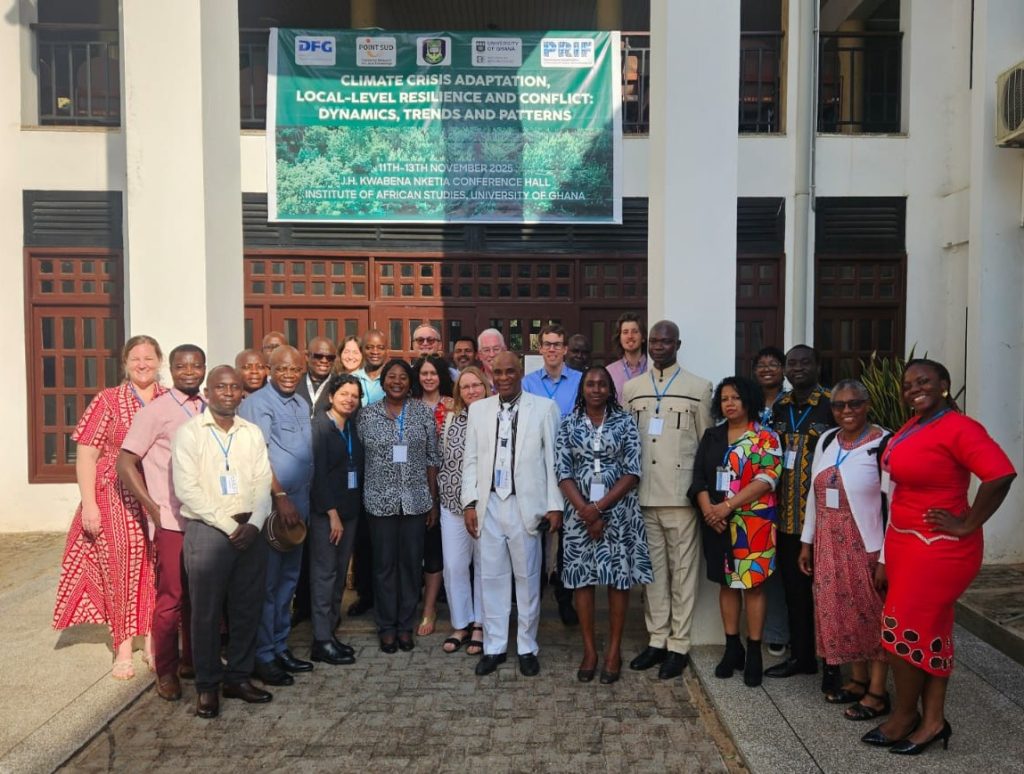
From November 10 to 14, 2025 in Legon, Accra, CONCRET-S participated to a workshop on “CLIMATE CRISIS ADAPTATION, LOCAL-LEVEL RESILIENCE AND CONFLICT: DYNAMICS, TRENDS AND PATTERNS”, organized by the University of Ghana, the Centre for Peace and Strategic Studies, University of Ilorin, as well as the Peace Research Institute Frankfurt.
This workshop examined the combined effects of the climate crisis, adaptation strategies, and societal dynamics on violent conflict, versus factors promoting resilience and crisis mitigation. The goal was to identify the risks and opportunities of lived adaptation practices, understood as « attributes or capacities that enable a community to endure, respond, or recover from climate-related crises » (Obi & Babatunde, 2019). Focus was be placed on “endogenous strengths in systems, structures, and people within climate-impactedsocieties” (ibid.).
The increasing severity of the climate crisis and challenges in meeting the 1.5°C target have shifted the focus from mitigation to adaptation at COP 28, emphasizing the need for innovative, cost-effective strategies. In the Global South, particularly Africa, societies face heightened vulnerability to both climate change and climate-related conflict. Vulnerable groups, such as children, women, and the elderly, are most affected by climate change induced impacts (McMichael, 2017). Oil extraction in African countries like Nigeria, Angola, and Algeria exacerbates the crisis (Daggett, 2018; Watts, 2007), fueling environmental violence and conflict (Pegg & Zabbey, 2013; Babatunde, 2017; Le Billon, 2021; Obi, 2023). Climate change also worsens competition for resources in rural areas, where droughts, floods, and other extreme weather events trigger migration (Niyitegeka, 2023). Climate-related conflicts amplify the harms of climate change itself, aggravating poverty, food insecurity, political instability, and increasing the risk of renewed conflict (Peters & Vivekananda, 2014; Hickey and Mohan, 2021; Babatunde, 2023). Moreover, African women, particularly in rural areas, face increased vulnerability due to structural inequalities, such as limited access to resources. Despite their critical roles in managing environmental resources, women are often excluded from decision-making at local, national, and international levels (Cole, 2016; Peˇsa and Ross, 2021). Understanding the gendered dimensions of climate change impact is therefore crucial to identifying sustainable adaptation practices.
Although the vulnerability of African countries to climate-induced conflicts is well recognized (Raleigh, 2010; Huber, 2022; Hegazi and Seyuba, 2024), comprehensive studies of adaptation practices remain scarce. Many African nations lack the financial and technological capacity for effective climate policy implementation. Nevertheless, local communities are employing strategies to build resilience (Cobbinah, 2021; Appau et al., 2024). Global climate policies have not sufficiently addressed these local-level strategies although they might be key to designing policies that are both cost-effective and responsive, e.g. to the needs of vulnerable groups.
The workshop aimed to explore the historical and ongoing practices of local-level climate adaptation and resilience, focusing on indigenous knowledge and its relevance today. African regions have long dealt with climate-related stress, and research on traditional strategies offers valuable insights into long-term adaptive responses. It was examined how these indigenous practices intersect with contemporary strategies, including digital technologies, to address both old and new challenges. The role of local adaptations in urban settings were considered.
By bringing together scholars from across Africa and other parts of the globe with expertise in climate research, history, agriculture, anthropology, environmental studies; political science, and conflict studies, the organizers aimed to gain a deeper understanding of the conditions for local resilience. The goal was to break disciplinary and continental boundaries to better address the risks posed by climate change.
CONCRET-S specifically participated to an important roundtable discussion on “Climate Crisis Adaptation, Local-Level Resilience and Conflict – Constraints and Opportunities for Effective Climate Action Planning « during which exchanges on the adverse impacts of the rush for critical minerals in the Global South countries could be held.